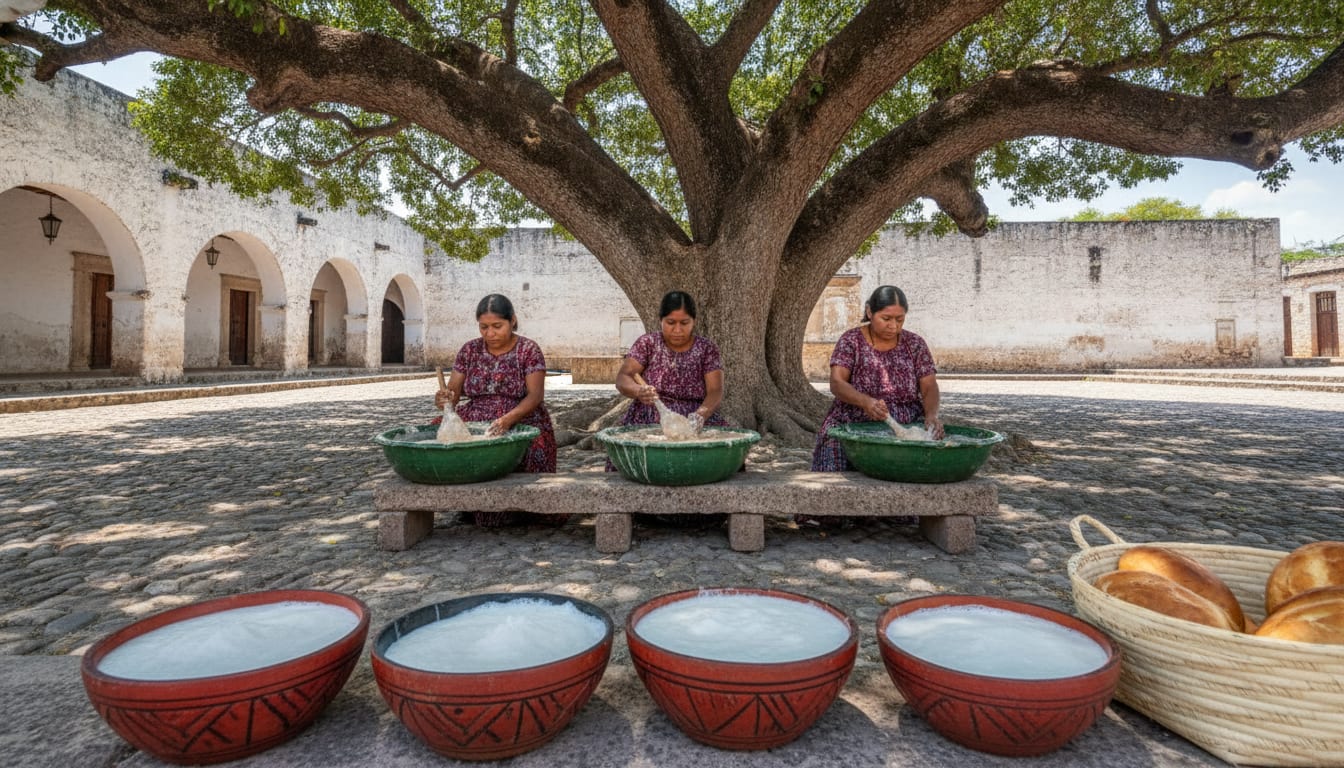
San Andrés Huayápam: The Origin of Tejate and Mexican Roots
"Discover San Andrés Huayápam, the Oaxacan village where cocoa-inheriting women preserve tejate, the ancient drink defining Mexico."
Location
20 minutes from downtown Oaxaca
Average cost
$25 - $40 MXN per jícara of tejate
Best time
Sunday mornings or Palm Sunday (Tejate Fair)
There are many ways to try to understand Mexico's cultural vastness, but few are as sincere and direct as through its palate. To truly know the soul of this country, reading essays on its pre-Hispanic history is not enough; one must travel to the specific places where that history is still alive, beating in the hands of its people. In Oaxaca, that gateway has a name, an aroma of roasted cocoa, and an exact location: San Andrés Huayápam, a peaceful village in the foothills of the Sierra Norte that jealously guards the title of being the world cradle of tejate.
Just twenty minutes from the Oaxacan capital, Huayápam welcomes you with cobblestone streets, the echo of its 16th-century church, and above all, the cool shade of ancient trees. Here, Mexico's heritage is not kept behind glass cases or in museums... it is served fresh, crowned by a cloud of white foam, inside carved red wooden jícaras (gourd bowls).
🌸 The Secret Ingredient: The Rosita de Cacao
Tejate is known as "the drink of the gods," an ancestral blend that Zapotec and Mixtec cultures used in sacred ceremonies. But what makes Huayápam's tejate the authentic and original one? The answer grows in their backyards.
It is the rosita de cacao (quararibea funebris), a white, small flower with an intensely sweet aroma born from a tree endemic to this region. Without this flower, tejate simply does not exist. For centuries, the families of Huayápam have cultivated these trees, harvesting the flowers that fall to the ground to dry them in the sun. It is this ingredient, added to corn, fermented cocoa, and mamey pit (pixtle), that gives the drink its unmistakable flavor and that thick texture that refreshes the soul at noon.
🤲 The Tejateras: Alchemists of Memory
Behind every jícara of tejate lies hours of meticulous labor, sustained by the hands of the women of Huayápam. Being a tejatera is a title of honor inherited from mothers to daughters, a form of cultural resistance that keeps Mexico's identity alive.
The process begins at dawn. Ingredients are toasted on clay comales (griddles) and ground on volcanic stone metates (grinding stones) until forming a fine paste. Then comes the true ritual: in large glazed green clay apastes (large basins), the tejatera dissolves the paste with cold water. With clean hands, she whips the mixture from the bottom, a rhythmic and precise movement that makes the cocoa fat rise to the surface, creating that characteristic lumpy, white foam that looks like snow. Watching them work under the shade of a canopy in the main square is to witness a rite that has survived intact through the conquest and the passing of centuries.
🥐 The Perfect Pairing: The Bakery of the Valleys
Drinking tejate in Huayápam is only part of the experience; the other is pairing it with the traditional bakery of the Central Valleys. Around the tejate stalls you will always find baskets overflowing with pan de yema (yolk bread), pan amarillo, and, if you are lucky during local festivities, you can experience monumental baking traditions like the famous pan de borrego, huge pieces representing abundance and community celebration in the region.
For travelers looking to delve deeper into the flavors of this land, the experience doesn't have to end in Huayápam. Back in the city, you can complement this journey to pre-Hispanic roots by enjoying an authentic Comida tradicional oaxaqueña in the historic center, or completely immerse yourself in ancestral processes by taking a Clase de cocina oaxaqueña, where you will learn firsthand the value of smoke, corn, and the metate.
📍 How to Plan Your Visit to San Andrés Huayápam
If you want to live this experience closely, here are some tips for your trip:
👉 When to go: Although there are tejateras every day in the center of town and in Oaxaca's markets, the best time to go to Huayápam is Sunday morning.
👉 The Tejate Fair: If you visit Oaxaca in spring, mark your calendar. Every Palm Sunday, the entire village celebrates the Tejate Fair. The streets fill with dozens of women whipping their apastes in unison, brass band music, chichilo tamales, and amarillo empanadas.
👉 How to get there: From downtown Oaxaca, you can take a collective taxi or an urban bus near the Central de Abasto or the Baseball Stadium. The trip takes less than half an hour.
👉 What else to see: Be sure to visit the Temple of San Andrés Apóstol, famous for its impressive wooden carved altarpieces bathed in gold leaf, a jewel of New Spanish baroque.
✨ The Taste of Identity
San Andrés Huayápam is not just a dot on the map of Oaxaca; it is the clay bowl where Mexico continues to drink from its own origin. Every jícara that a tejatera offers you with a smile is a bridge between the past and the present, palpable proof that the most sacred traditions are not made of stone, but of corn, cocoa, and community... waiting to be discovered by those who know how to travel with an open heart.
San Andrés Huayápam
San Andrés Huayápam, Valles Centrales, Oaxaca, México